

What Can I Do With This Property? An Architect's Guide to South Bay Home Expansion Options, Zoning Rules, and Choosing the Right Project
Written by Eyal Ravid, RA | California Licensed Architect C35265
Principal Architect, Prestin Ravid Architects
About This Guide
Most homeowners arrive at the first meeting with a project type already chosen. They want a second story, or they want a full remodel, or they have decided to tear down and rebuild. We almost always back up. Before any project type gets selected, we want to know what the property can actually support, because the regulatory container in Saratoga is categorically different from the one in San Jose, and the design conversation looks completely different depending on what that container allows.
The answer to that question is different in Cupertino than it is in Saratoga, different again in Palo Alto or Los Gatos. It comes from the property's zoning envelope: the regulatory container defined by FAR limits, setbacks, height restrictions, daylight planes, and in design-review cities, the qualitative expectations of planning staff layered on top of all of that. Understanding that envelope before choosing a project type is the intelligence that belongs first.
City-specific permitting processes live on each city's dedicated residential architect page. What this guide covers is the architectural layer beneath those processes: how the envelope works, what the four spatial transformation patterns are, how city-specific rules create different spatial possibilities, and how we evaluate which pattern fits a specific property.
Written for homeowners who are pre-project, before they have committed to a second story addition, a remodel, or a new build, and want to understand what their property can actually become. Tell Us About Your Project
How to Use This Guide
This guide belongs before the project type decision. Start with Part I to understand the regulatory framework. Move to Part II for the four spatial transformation patterns. Part III shows how city-specific rules create different possibilities in Cupertino, Los Gatos, Saratoga, and Palo Alto. Part IV provides the decision framework.
This guide reflects how we approach early-stage projects at Prestin Ravid Architects with understanding constraints first, design second. If you'd prefer to see how we work before reading further, see how we work.
Part I: Your Zoning Envelope
A homeowner in Cupertino calls after receiving a contractor's proposal for a second story addition. The contractor has priced a 1,200 sqft second floor on a 1,800 sqft first floor. The homeowner wants to know if the budget makes sense before signing.
We ask two questions before anything else: what is the existing total floor area of the house, and what is the net lot size? The homeowner checks. The house is already at 3,900 sqft on a 9,200 sqft lot. Cupertino's R-1 FAR limit is 0.45, a maximum of 4,140 sqft total. The FAR budget remaining is 240 sqft. The contractor's proposed 1,200 sqft second floor would require a variance. The project the homeowner was about to sign a contract for was not permittable as proposed.
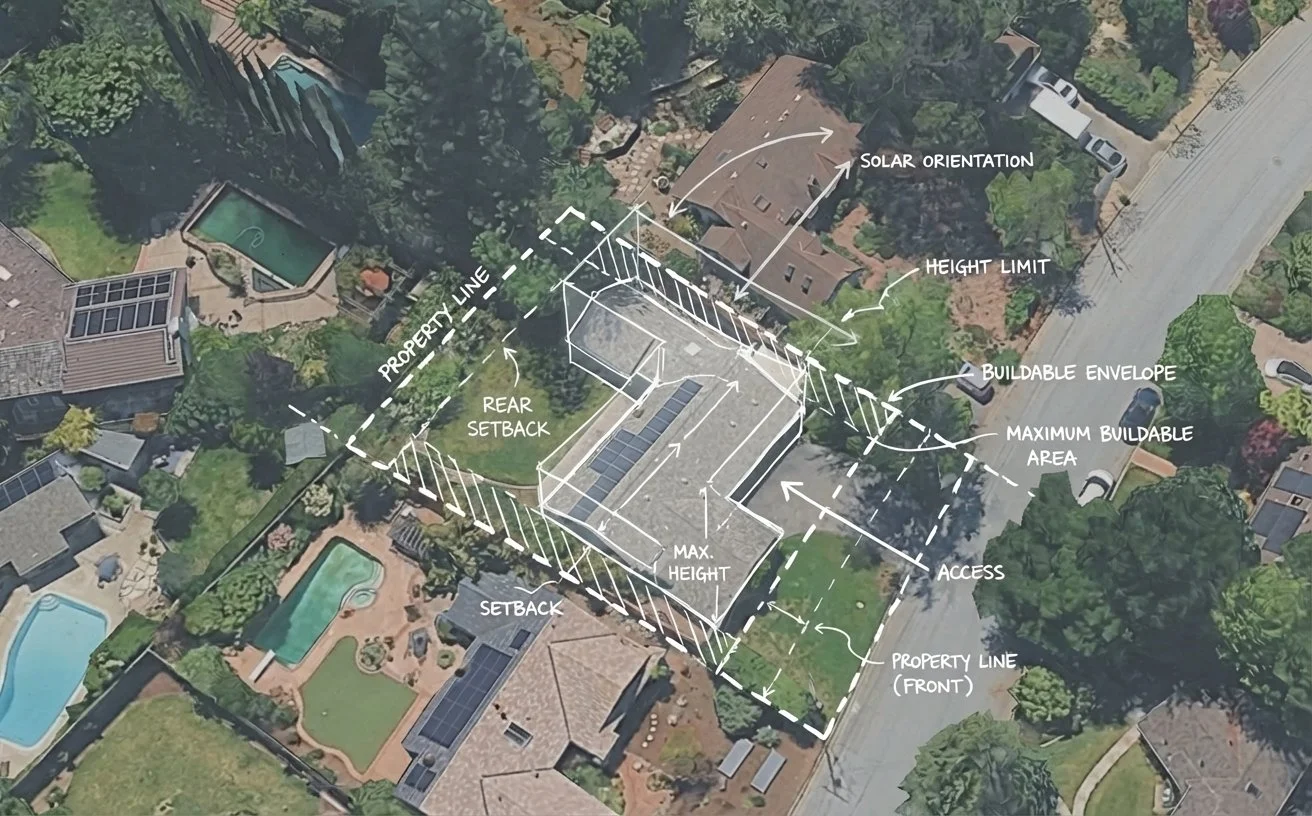
The regulatory container, FAR limits, setbacks, height limits, daylight planes, and the qualitative expectations of planning staff in design-review cities, determines what can be built before design begins. We map it first. Everything else follows from that map.
FAR: The Master Constraint
FAR is the ratio of total building floor area to net lot area, and every square foot you build across the primary home, a second floor, and accessory structures draws from the same budget. In Cupertino's R-1 zone, the maximum FAR is 0.45. On a 10,000 sqft lot, that is 4,500 sqft maximum for everything combined. If the existing home is already 3,800 sqft on that lot, the remaining 700 sqft of FAR is where the expansion conversation begins, and that number often changes the project direction before design begins.
FAR is calculated against net lot area, not gross. Drainage easements, flag portions of lots, creek setbacks, and right-of-way areas can be excluded from net lot area, reducing the FAR budget below what a simple lot size suggests. This is one of the most common feasibility surprises on Peninsula estate lots: a property with a 20,000 sqft gross lot and a 6,000 sqft drainage easement has 14,000 sqft of net lot area for FAR purposes, and the program the homeowner planned for the larger number may not fit within the smaller one.
FAR is the master constraint. Every other regulatory variable, setbacks, height limits, daylight planes, operates within it.
Setbacks: The Horizontal Container
Setbacks define minimum distances from the building to each property line, creating the buildable footprint at grade. In most South Bay R-1 zones: 20 feet at front, 20 feet at rear, 5 to 10 feet at each side for single-story construction. For second stories, setbacks tighten. In Cupertino, second-floor walls between 10 and 15 feet from a side line trigger Residential Design Review. In Saratoga, second-floor setbacks are governed by the Objective Design Standards. In Palo Alto, both IR and ODS have setback requirements that shape the second floor's relationship to the street.
The practical consequence: a lot with adequate FAR remaining may still not support a specific addition because the setbacks prevent the footprint from going where the program needs it. FAR budget and setback geometry must be evaluated simultaneously. One without the other produces a picture that looks feasible on one dimension and is not on the other. This is how projects reach schematic design before discovering the footprint cannot go where the floor plan requires.
A lot with adequate FAR remaining may still not support the addition because the setbacks prevent the footprint from going where the program needs it.
Height Limits and the Building Envelope
Most South Bay R-1 zones cap structure height at 28 to 30 feet. More relevant for addition design is the building envelope: the three-dimensional shape within which all construction must fit. In Cupertino, the building envelope begins as a 10-foot vertical line at the property line, then slopes inward at 25 degrees toward the center of the lot. That slope, not a simple height cap, is what determines the architectural form of a Cupertino addition before any design decision is made. A second floor that fits within FAR and setback requirements may still exceed the building envelope, requiring the roof to slope differently or the footprint to step back further.
Daylight Planes: The Invisible Architecture
The daylight plane is a sloped regulatory surface that angles away from the property line as the building rises, limiting how close a second story wall can come to the property line at height. In Cupertino, it is the building envelope described above: 10-foot vertical surface at the property line, then 25 degrees inward. A second-floor wall cannot penetrate this surface even if it meets the setback minimum.
In Palo Alto, the daylight plane question is answered differently depending on the neighboring lot. The city's February 2025 Two-Story Objective Design Standards specify that where the neighboring lot is single-story or has a second-floor area of 500 sqft or less, the side daylight plane is measured from 8 feet above grade rather than 10 feet. That 2-foot difference is not minor. It affects how far the second-floor wall can extend at height before the slope cuts in, which directly changes the usable floor area near the side walls. An architect who applies the standard 10-foot plane on those lots produces massing that exceeds the ODS criteria.
The daylight plane is not a regulatory inconvenience. It is the three-dimensional shape of what can be built. We design within it from the first sketch.
How City Design Review Changes the Envelope Equation
In South Bay and Peninsula cities with discretionary design review, the zoning envelope is necessary but not sufficient. The envelope defines what the code allows. Design review evaluates whether what the code allows is what planning staff will approve. These are different questions, and the gap between them is where most Saratoga and Los Gatos projects either succeed or generate comment letters.
In these cities, the envelope is not just what the code allows. It is what planning staff will approve. An architect who designs to the code maximum in Saratoga or Los Gatos is designing to a target that will be revised.

Part II: Expansion Options
Most homeowners begin with a vision: more space, a better connection to the backyard, a larger kitchen, a primary suite, or a home that finally works for the way they live.
The challenge is determining which path can actually achieve that vision. A second story addition, a ground-level expansion, a structural reconfiguration, or a complete transformation each comes with different opportunities and constraints. The property's zoning, existing structure, lot conditions, and city approval process all influence what is realistically possible.
Before developing a design direction, we identify which transformation path best fits the property, the homeowner's goals, and the investment being considered.
The right solution is not simply the one that adds the most square footage. It is the one that creates the best long-term outcome within the opportunities and constraints of the property.
Adding a Second Floor
When the property needs more space but the lot cannot expand outward.
Many homeowners considering a second story already know what they want to gain: additional bedrooms, a primary suite, more living space, or separation between family areas. The natural assumption is that the next step is drawing the floor plan.
The first question is whether the property can support that vision. A second floor depends on factors most homeowners cannot see: the existing foundation, available building envelope, allowable floor area, and the city's approval process. Understanding these constraints before design begins prevents a common problem: investing time and money into a plan that later needs to be redesigned because the structure, budget, or permit path was not considered early enough.
In Cupertino, the second-floor footprint size relative to the first floor determines the permit track — the 66% ratio is a design variable, not a ceiling. In Saratoga, ODS compliance determines which of three Design Review paths the project takes. In Palo Alto, the massing relationship between the second floor and the block-face streetscape is evaluated at IR or against ODS criteria. In Los Gatos, the program must stay below 100 sqft of second-floor addition to avoid A&S Review, unless that review is worth accepting for the program it enables.
The structural question is especially important for many South Bay ranch homes built from the 1950s through the 1980s. Post-and-pier foundations in Cupertino, Sunnyvale, and Mountain View almost always require reinforcement before a second floor is viable. That reinforcement cost and the shear wall placement it requires influences the first-floor layout, not just the new second floor. We establish shear wall locations before the floor plan is set.
The most common mistake with a second story addition: designing the rooms before understanding whether the property can support the addition.
Adding Space Through a Ground-Level Addition
When the property has room to expand outward.
When homeowners learn a second story may be challenging, expanding outward often feels like the simpler alternative. Sometimes it is. Sometimes it creates a different set of challenges.
A ground-level addition depends on the relationship between the home's footprint, setbacks, lot coverage limits, trees, and city regulations. The question is not only whether more space can be added, but whether that space can be added in the right location. A lot with adequate FAR remaining may not have the setback clearance to place the addition where the program needs it.
In Saratoga and Los Gatos hillside zones, impervious surface limits add another layer: these cities cap the percentage of lot area covered by impervious surfaces to protect drainage and watershed conditions. A horizontal addition that fits within setbacks and FAR may still exceed the impervious surface limit. Protected tree canopy is equally critical — a footprint that conflicts with a protected tree's canopy dripline requires a complete redesign from the arborist's map, not an adjustment.
In Los Gatos flatland neighborhoods, a rear addition that stays below the 50% footprint expansion threshold stays in the simpler permit track. That arithmetic is worth running at schematic design before any design direction is committed to, because it can change the project type entirely. Understanding those tradeoffs early allows the design direction to follow what the property can actually support rather than forcing the property into a predetermined idea.
Going out is not always simpler than going up. The right solution depends on what the property can support.
Transforming the Existing Home Without Expanding
When the problem is the layout, not the square footage.
Not every home needs more space. Sometimes the challenge is that the existing space no longer supports the way the family lives. Many South Bay homes were built around a different lifestyle: smaller rooms, separated spaces, and layouts that do not provide the connection and flexibility homeowners want today.
A structural reconfiguration can completely change the experience of a home without adding square footage. Removing walls, improving circulation, and creating stronger connections between spaces can transform how the home functions. The key is understanding what can be changed and what structural implications come with those changes. A wall that appears removable may carry significant loads. A larger opening may require structural solutions that affect ceiling height, mechanical systems above, and the foundation below.
One thing that surprises homeowners consistently: a permit is required even when the footprint does not change. Any structural modification requires a building permit in South Bay and Peninsula cities. In Saratoga and Los Gatos, structural modifications accompanied by exterior changes that meet trigger thresholds will pull the full Design Review process into a project that seemed like it might avoid it. We evaluate the full scope against every threshold before any design begins, not just the structural scope.
Adding square footage is not always the answer. Sometimes the best transformation is making the existing home work better.
Complete Home Transformation
When the existing home no longer supports the way the family wants to live.
Some projects are not about adding a room or changing a few walls. The challenge is that the entire home needs to work differently. When the existing first floor is spatially inefficient — rooms sized for a 1962 family, circulation patterns that do not serve how the household actually lives — adding a second floor on top produces an expensive result that still does not work.
A complete transformation considers the home as one connected system: how spaces relate to each other, how the first floor supports the second floor, how the design responds to the site, and how the project can move successfully through the approval process. Rather than adding a new floor onto an outdated layout, this approach creates a home where the structure, function, and exterior character are designed together from the beginning.
The planning intelligence question before committing: does the full scope of reconfiguration require Planning Commission review in Saratoga through demolition triggers, or full A&S Application in Los Gatos through reconstruction thresholds? The permit arc for a full transformation is evaluated against all trigger thresholds, not just the second-floor addition thresholds. For many homeowners, this creates a better long-term result because the project is not solving one isolated problem. It is creating a home that works as a whole.
The best transformations do not treat additions and renovations as separate decisions. They solve the entire home as one design problem.
Part III: City Envelope Behavior
The same property, same lot size, same existing floor area, same program, encounters a different envelope in each South Bay and Peninsula city. These are not minor administrative differences. They determine which transformation patterns are viable, what the permit timeline will be, and what the completed project can look like.
Full permitting process detail for each city, exact triggers, timelines, required submittals, what creates approval friction, is on each city's dedicated residential architect page. What follows here is the envelope behavior layer: how each city's regulatory culture shapes the range of what is architecturally viable.
Cupertino: Envelope Optimization and Permit Track Design
When we evaluate a Cupertino property for a second story addition, the first thing we calculate is what is left in the FAR budget. Cupertino's R-1 FAR of 0.45 means that on a 10,000 sqft lot, the maximum total floor area for everything is 4,500 sqft. If the existing home plus garage is already at 3,800 sqft, there is 700 sqft of FAR remaining, and that number changes the project conversation before a single line is drawn. On a 7,500 sqft lot, the maximum is 3,375 sqft.
What most architects and almost all contractors miss: interior building area above 16 feet counts twice toward FAR in Cupertino. A vaulted great room with an 18-foot ceiling consumes more FAR budget per square foot of floor than a standard 9-foot ceiling room. We detail the ceiling plan on constrained lots specifically to protect the FAR budget. It is an architectural decision with a regulatory consequence that is not visible in a basic floor plan.
The 66% second-to-first floor ratio is the central optimization variable in Cupertino second story work. We calculate both options at schematic design, what the program looks like at 65% of the first floor versus 75%, and present the tradeoff before any design commitment is made. A program that requires 900 sqft on a 1,200 sqft first floor, triggering Design Review at 75%, may be achievable at 780 sqft, the Two-Story Permit track at 65%, with different room arrangements. That 120 sqft difference is a permit track decision worth examining before anything is drawn. The design implications are minimal. The permit timeline implications are 4 to 8 weeks.
In Cupertino, ceiling height decisions are FAR decisions. A vaulted living room with an 18-foot ceiling costs more than floor area alone.
Los Gatos: Flatland and Hillside Envelope Differences
The first question on any Los Gatos addition is whether the program can be achieved without crossing an A&S Review trigger threshold. Seven triggers govern this in Los Gatos. Second story additions over 100 sqft is the most common one we are designing around. The difference between 95 sqft and 110 sqft of second-floor addition is the difference between Minor Residential Development and a full A&S Application. That is a 6 to 10 week timeline difference and several thousand dollars in application fees. Fifteen square feet is a decision we make in schematic week one, explicitly, with the homeowner, before anything is drawn.
Hillside Los Gatos, the terrain-responsive lots ascending toward the Santa Cruz Mountains, adds constraints that have no flatland equivalent. Geotechnical clearance must be obtained before Design Review approval, which means the geotechnical report must be initiated concurrent with design development, not after. Grading restrictions, access road grade limits, and protected tree canopy from neighboring properties all shape what is possible before any design direction is established.
The difference between 95 sqft and 110 sqft of second-floor addition in Los Gatos is a permit track decision made in schematic week one.
Saratoga: Design Review as the Primary Envelope Modifier
In Saratoga, the zoning envelope is the starting point. The effective envelope, what planning staff will actually approve, is consistently smaller. The ridgeline check is often the first thing that changes a design direction: a lot that looks buildable on a standard zoning analysis may have ridgeline visibility constraints that eliminate certain massing options before a sketch is made. Planning staff's material and design expectations narrow the practical specification range. Designing to the effective envelope from schematic design is not optional in Saratoga. It is how projects move through Design Review efficiently rather than cycling through redesigns.
Story poles for Path 3, Planning Commission, must be installed and approved before the public hearing can be scheduled, adding preparation time and cost that has to be planned from the start. Neighbor notification is required before application submittal on all three paths, not after. An arborist report is required whenever construction is proposed within five feet of any protected tree's canopy dripline, including trees on neighboring properties.
In Saratoga, the effective envelope is smaller than the code maximum. We design to the effective envelope from schematic design, not to what the FAR and setback numbers would theoretically allow.
Palo Alto: IR and ODS as Envelope Governance
In Palo Alto, second story massing is governed not only by FAR limits and setbacks but by how the addition responds to the block-face streetscape. Individual Review evaluates that compatibility qualitatively, a judgment made by staff who have reviewed multiple applications on comparable streets in the same neighborhood. An architect who has navigated IR on similar streets can anticipate that judgment before it is made. An architect who has not cannot.
Since February 2025, the ODS path provides a measurable alternative: design to the specific criteria and receive ministerial approval without IR. The daylight plane specificity in those standards, measured from 8 feet above grade rather than 10 feet where the neighboring lot is single-story or has a second floor of 500 sqft or less, is more constraining than most homeowners expect. We evaluate both paths at schematic design and recommend before massing commitments are made.
In Palo Alto's Eichler neighborhoods, Greenmeadow, Fairmeadow, Green Gables, and Charleston Meadow, planning staff applies sensitivity to additions that are stylistically incompatible with Eichler character. This is not codified, but it is real, and it shapes the design from schematic design in those neighborhoods.
In Palo Alto, massing compatibility with the block-face streetscape is a design variable from schematic design week one, not a condition discovered at IR submittal.
Part IV: Choosing the Right Project
The right spatial transformation pattern is not the one that produces the most square footage. It is the one that the property's envelope supports, that the permit process in the specific city accommodates, and that achieves the homeowner's program within a realistic budget and timeline. Three questions, evaluated simultaneously, determine the answer.
The Three Questions We Ask Before Recommending Any Design Direction
What does the envelope allow?
We map the remaining FAR, test the setback geometry against the proposed footprint locations, validate the permit track thresholds for the proposed scope in the specific city, and check overlay zones: ridgeline, geotechnical hazard, heritage tree canopy, hillside impervious surface limits. This is Phase 0. It determines which transformation patterns are physically possible before any design direction is suggested.
What does the foundation support?
If vertical expansion is in the viable set, we test structural candidacy before design begins. The foundation type, condition, and configuration determine whether a second floor is viable and at what cost. We establish this before the floor plan is drawn, because foundation conditions discovered during construction are the most expensive version of a problem that was identifiable in Phase 0.
What does the permit process require?
We test the permit track implications of each viable pattern before recommending one. A pattern that is physically feasible and structurally viable may not be practical if it triggers a 14-week Design Review process in Saratoga against a specific occupancy timeline. We sequence this analysis before the design direction is committed, because redesigning to a different permit track after schematic design is complete is one of the most consistently avoidable costs in South Bay residential work.
The permit process implications for each viable pattern have to be evaluated before any design direction is committed to. Redesigning to a different permit track after schematic design is complete is one of the most consistently avoidable costs in South Bay residential work.
Pattern by Property Condition
The framework below is the starting point. A feasibility assessment applies it to a specific property: actual FAR calculation, specific foundation condition, specific permit thresholds for the proposed program, specific overlay zones that apply.
The Honest Answer by City
We cannot answer which pattern is right from a description of the property. We need the FAR calculation, the foundation type, the city, and the specific program to give a real recommendation. But we can tell you what consistently drives the answer.
The FAR budget and ratio math drive everything
Most Cupertino properties at R-1 density have limited FAR remaining, which constrains both horizontal and vertical options. The 66% ratio determines whether vertical expansion lands in the Two-Story Permit track or Residential Design Review. The foundation type determines what vertical expansion will cost. These three variables answer the question for most Cupertino properties before any design begins.
Tree canopy frequently overrides the zoning analysis
The primary driver in Saratoga is frequently the tree canopy, not the FAR budget and not the zoning limits. Properties with significant valley oak or coast redwood canopy from neighboring lots can have their practical buildable area reduced significantly by arborist dripline requirements. We evaluated a Saratoga property where the zoning analysis showed 800 sqft of FAR remaining, setbacks were workable, and ODS compliance looked achievable. The arborist survey showed canopy driplines from three neighboring properties covering 60% of the rear yard. The buildable zone that avoided all protected driplines was a 400 sqft footprint in the corner of the lot furthest from the house, not the location the program required. The entire project direction changed. The arborist survey came back before the first site plan sketch was drawn. That sequencing decision prevented $30,000 in design work from being discarded.
Flatland and hillside require completely different evaluation sequences
The flatland versus hillside distinction determines the entire evaluation sequence. Flatland: trigger analysis first, then setbacks and FAR. Hillside: geotechnical check first, then ridgeline visibility, then everything else. The hillside project that proceeds without geotechnical clearance in Los Gatos is the project that stops at final Design Review stages while clearance is obtained, months lost at the most expensive point in the process.
What a Feasibility Assessment Delivers
The framework above is the starting point. A feasibility assessment applies it to the specific property: the actual FAR calculation, the specific foundation condition, the specific permit thresholds for the proposed program size, the specific overlay zones that apply. The output is a written assessment, not a verbal opinion, that identifies which transformation patterns are viable on the property, what each will approximately cost, which permit process each triggers, and which pattern best matches the homeowner's program and timeline.
This assessment is most valuable before design begins. It is also valuable before a property is purchased, when the question is which pattern is feasible on a property being considered, not one already owned.
The framework is the starting point. A feasibility assessment applies it to your specific property, your specific program, and your specific city before any design direction is committed to.
Frequently Asked Questions
How do I know which project type is right before I talk to an architect?
What is FAR and how does it affect what I can build in the South Bay?
How do I find out my property's FAR limit in Cupertino, Saratoga, or Palo Alto?
Can I add a second floor to a home that is already near its FAR limit?
What is a daylight plane and how does it affect my second story addition?
How does Saratoga Design Review change what I can build beyond what the zoning code allows?
What is the difference between vertical expansion and horizontal expansion?
How do I know whether a second story addition or a ground-floor addition makes more sense for my property?
Does interior reconfiguration require a building permit?
What is the difference between a full transformation arc and a standard second story addition?
How does the Cupertino 66 percent floor area ratio rule affect my design options?
What is the February 2025 Palo Alto ODS change?
When should I use this guide versus the Project Planning Guide?
Project Execution Guides
City Residential Architect Pages
Additional South Bay City Pages
Peninsula City Pages